
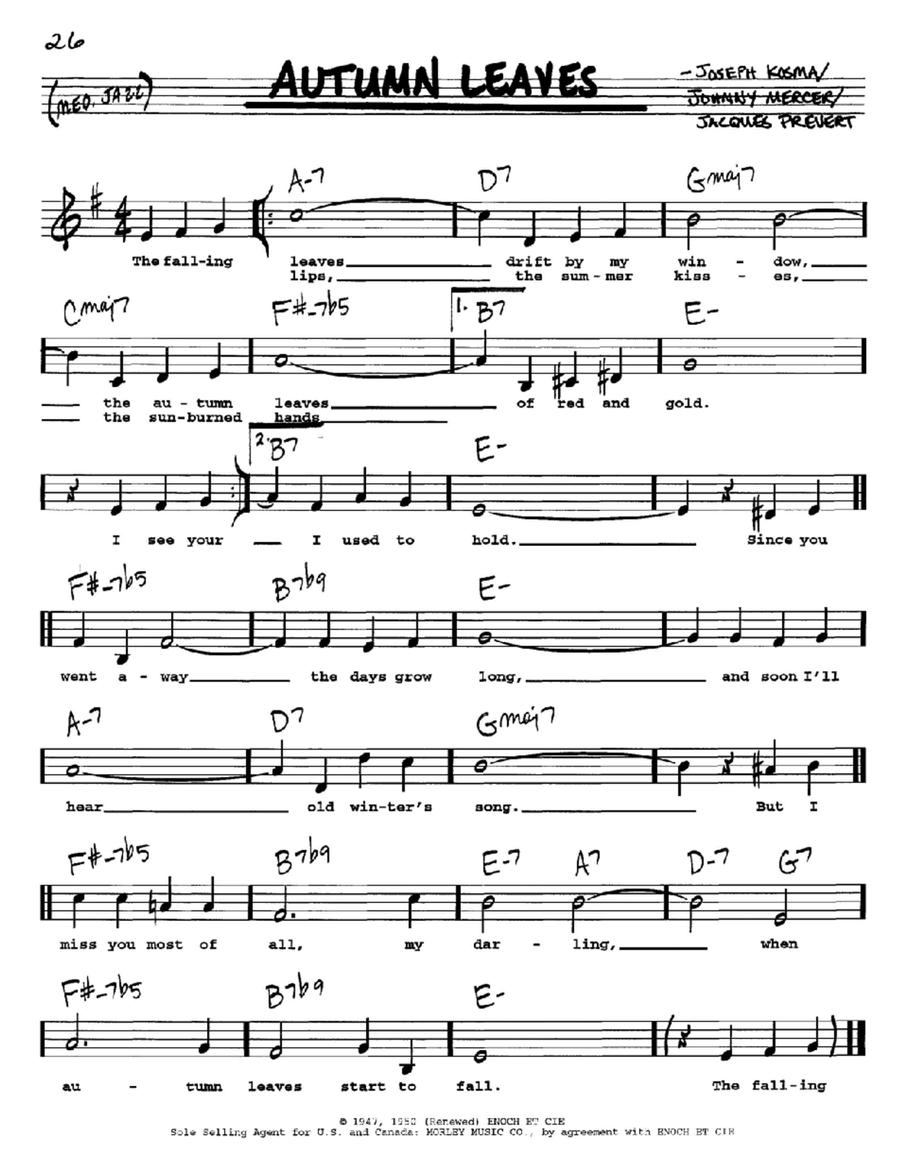
Autumn Leaves Lead Sheet: Complete Analysis, History, and How to Master It
The Autumn Leaves lead sheet sits at the heart of the jazz repertoire. If you want a tune that teaches rock-solid ii–V–I movement, relative major–minor relationships, and lyrical phrasing, this is it. In this long-form guide you will learn the origin of the song, how its harmony is constructed, what scales and voice-leading approaches actually work on the bandstand, and how to practice it so you can perform confidently. You will also find listening recommendations, arrangement ideas, and pointers to trusted resources, including Minedit for additional lead sheets and study materials.
What Is the Autumn Leaves Lead Sheet and Why It Matters
At its simplest, a lead sheet gives you the melody and chord symbols. For Autumn Leaves, those symbols encode some of the most reusable progressions in jazz. The tune toggles between a relative major and its relative minor, letting you practice both major and minor cadences in one compact form. Because of that, the song becomes a perfect laboratory for learning jazz harmony, improvisation, and comping.
Brief History and Origin Story
Autumn Leaves began life as “Les Feuilles mortes,” composed in 1945 by Joseph Kosma with French lyrics by Jacques Prévert. Johnny Mercer later wrote the English lyrics that helped the song cross into the American songbook. Over the following decades it was recorded by icons such as Miles Davis, Cannonball Adderley, Bill Evans, and Ella Fitzgerald, cementing its place as a global standard. For a concise background on the composer and lyricists, see entries on Joseph Kosma and Jacques Prévert.
Form and Key Centers
The tune is typically played in a 32-bar form with an AABA or ABAC-like feel depending on the edition you consult. In the most common Real Book variant in concert G minor, the A section cadences through the relative major (B♭ major) and resolves to G minor, while the B section continues the cycle and returns to the tonic minor. Singers often call it in E minor, while horn players frequently learn it in G minor and sometimes F minor. No matter the key, you will encounter the same movements: a major ii–V–I and a minor iiø–V–i.
The Core Progression You Must Internalize
Think of the harmony as two locks you can open with one key concept: cadences. First you experience a ii–V–I in the relative major, then a iiø–V–i in the relative minor. In concert G minor, the opening typically moves Cmin7 to F7 to B♭maj7 to E♭maj7, then cycles to Amin7♭5 to D7 to Gmin. This elegant pendulum between major and minor is what makes the lead sheet so useful. If you can hear those resolutions, improvisation starts to feel inevitable rather than forced.
Guide Tones and Voice Leading
Great lines follow great voice leading. Emphasize the third and seventh of each chord, because those tones define quality and pull the harmony forward. For example, the E♭ (third of Cmin7) moves to E natural (third of C7 if you tritone-sub later) or to A (third of F7) in a classic inner voice motion. Land on D (third of B♭maj7) to make the cadence feel complete. When the minor cadence arrives, let the F (third of D7) resolve to G (tonic of Gmin) and treat the B♭ (seventh of Cmin7) with care, as it can move smoothly down to A (third of F7) or up to B natural for an altered color over the dominant.
Scale Choices That Actually Work
Keep your scale palette simple and functional. Over the major ii–V–I, use Dorian over the ii chord, Mixolydian or Lydian Dominant over the V, and Ionian over the I. Over the minor iiø–V–i, use Locrian ♮2 or the sixth mode of melodic minor over the half-diminished chord, an altered scale or Phrygian dominant over the V, and Aeolian or Dorian over the i depending on color. These are not rules but starting points; the ear ultimately decides.
How to Hear the Cadences
Hearing the cadences turns the page of symbols into music. Sing the guide tones while comping basic shell voicings. Next, sing the melody and identify where it leans into chord tones at phrase endings. Finally, walk a simple bass line outlining roots and fifths, and notice how the melodic contour mirrors the falling-leaves imagery through descending lines.
Comping Approaches for Piano and Guitar
Pianists often favor rootless voicings built from 3rds and 7ths with color tones 9 and 13 in the major cadence, and 9 and 11 in the minor iiø. Guitarists can create momentum using drop-2 shapes on adjacent strings, reserving lower strings for bassist space. Keep your comping sparse behind solos, then fill more during interludes or backgrounds. Think conversation, not monologue.
Walking Bass and Rhythmic Feel
A walking bass should prioritize stepwise motion, common-tone retention, and chromatic approach notes into chord tones on strong beats. In swing, quarter-note consistency matters more than fancy runs. In bossa nova interpretations, simplify to a two-feel pattern and lock with the drummer’s cross-stick or hi-hat pattern. The harmony still breathes the same way, but the articulation changes.
Common Reharmonizations You Will Encounter
On the bandstand, expect tasteful detours. A frequent option is tritone substitution on the dominants, such as replacing D7 with A♭7 to create smoother bass motion. Some players insert secondary dominants, for example approaching E♭maj7 with B♭7. Others use diminished passing chords between diatonic changes. These devices heighten tension without abandoning the tune’s DNA.
Melodic Phrasing and Expression
The melody is deceptively simple. Shape phrases with breath and space. Lean into longer notes by adding a slight crescendo into the resolution. Place blue notes and chromatic enclosures around key chord tones at cadences. Above all, let the lyrical quality lead your articulation, especially in ballad and medium swing tempos.
Ballad, Medium Swing, and Bossa Interpretations
As a ballad, the tune invites rubato intros and lush voicings. At medium swing, it becomes a comfortable vehicle for solos and trading fours. As a bossa nova, the syncopation reframes the falling motif and brightens the mood. Each feel requires the same structural awareness but different touch, accent, and density.
How to Practice Autumn Leaves Efficiently
Start by learning the melody perfectly at a slow tempo with a metronome clicking on beats two and four. Add basic shell voicings and practice the A section repeatedly until you can predict every cadence. Next, arpeggiate each chord through the full range of your instrument. Then restrict yourself to only chord tones on downbeats while adding chromatic approaches on upbeats. Finally, improvise one chorus using only eighth notes, one chorus using only quarter notes, and one chorus limiting yourself to the top octave of your instrument. These constraints build precision and phrasing.
Transposition Strategy
Transpose the tune to at least three additional keys beyond your default. Begin by rewriting the guide-tone lines on staff paper or in your notation app. Then rebuild your shell voicings in the new key and test them against the melody. When you can play the A section in two keys back-to-back without stopping, you are ready to add the bridge and raise the metronome.
Ear Training with the Autumn Leaves Lead Sheet
Use the tune as an ear-training anchor. Sing the root motion while clapping beats two and four. Next, sing thirds and sevenths against a drone or keyboard. Record yourself and check intonation. Once you can consistently land guide tones by ear, the changes stop feeling like a maze and start feeling like a conversation you already know how to have.
Arranging Ideas for Small Ensembles
For trio, open with a rubato piano or guitar intro that quotes the bridge, then drop into tempo for the head. For quartet or quintet, consider harmonizing the A-section melody in thirds and unison on the bridge to create contrast. Add a stop-time figure in the last four bars before solos, then use a tag vamp on the final minor cadence to cue the ending.
Solo Construction: From Motif to Climax
Build solos by developing a small motif across the major and minor cadences. Repeat the motif with rhythmic variation over the ii–V–I in the relative major, then answer it in the minor cadence with a slight alteration. Reserve your densest lines for the final A section and release into a lyrical restatement of the melody before the out-chorus.
Typical Mistakes and How to Fix Them
Many players memorize the chord names but not the voice-leading. This leads to solos that sound like scale practice rather than storytelling. Another common error is ignoring the relative major–minor conversation, which flattens the tune’s emotional arc. Fix both by practicing slow, sparse lines that lean on guide tones at bar lines, then gradually add rhythm and color tones.
Recommended Listening and Study
Listen broadly to learn how different masters shape the harmony. The Miles Davis and Cannonball Adderley collaboration offers a poised medium-swing model. Bill Evans’s interpretations demonstrate floating time and harmonic translucence. For historical context and discography notes, consult entries on Autumn Leaves and explore reputable discography sites. Then return to your instrument and imitate one chorus from a favorite recording, phrase for phrase.
Reading and Lead Sheet Sources
Multiple legal editions exist across fake books and publisher catalogs. Cross-check melody details and chord qualities between sources, because small differences in notation can change how you hear the resolution. For additional practice materials and related standards, browse Minedit, where you can find companion guides and helpful reference charts.
Frequently Asked Questions
What key should I learn first?
G minor is common for concert instruments and E minor appears frequently in vocal settings. Start with whichever your ensemble calls most often, then add two more keys for flexibility.
Is it better to memorize the melody or the chords first?
Memorize both, but begin with the melody so you understand phrase shapes. Immediately afterward, sing the thirds and sevenths of each chord while comping simple shells. This locks melody and harmony together.
How do I make my solos sound less “scalar”?
Target guide tones on downbeats, add chromatic approach notes on the preceding upbeat, and repeat short motifs over both the major and minor cadences. Limit your vocabulary on purpose for a chorus to force clarity.
What tempo works best for learning?
Ballad and slow-medium tempos reveal the voice leading and let you hear resolution. Once your lines connect at 70 to 90 BPM, gradually increase tempo, keeping articulation relaxed.
Putting It All Together
When you return to the Autumn Leaves lead sheet, try this sequence: sing the melody, comp shell voicings through the form, arpeggiate every chord, and improvise one chorus using only chord tones on strong beats. Then add color tones and enclosure devices. Finally, play a full chorus that treats the A sections as call and the bridge as response, as if the harmony itself were telling a story.
Next Steps and Additional Resources
To deepen your practice, create a one-page worksheet listing the ii–V–I and iiø–V–i cadences in all twelve keys. Record yourself once a week and listen for clean resolutions at bar lines. For more study materials, walkthroughs, and related standards, visit Minedit. For historical notes on the writers and notable recordings, reputable encyclopedic sources such as Johnny Mercer and the song’s main entry provide concise starting points before you dive into discographies and liner notes.
Conclusion
Autumn Leaves endures because it teaches you how harmony moves and how melody breathes. Master the cadences, hear the guide tones, and practice with musical constraints. Do that, and the lead sheet becomes more than ink on a page; it becomes a map to confident improvisation and elegant ensemble playing. Keep exploring, keep listening, and use this tune as a lifelong companion in your jazz journey. When you are ready to expand, continue your study with resources and related guides at Minedit.