
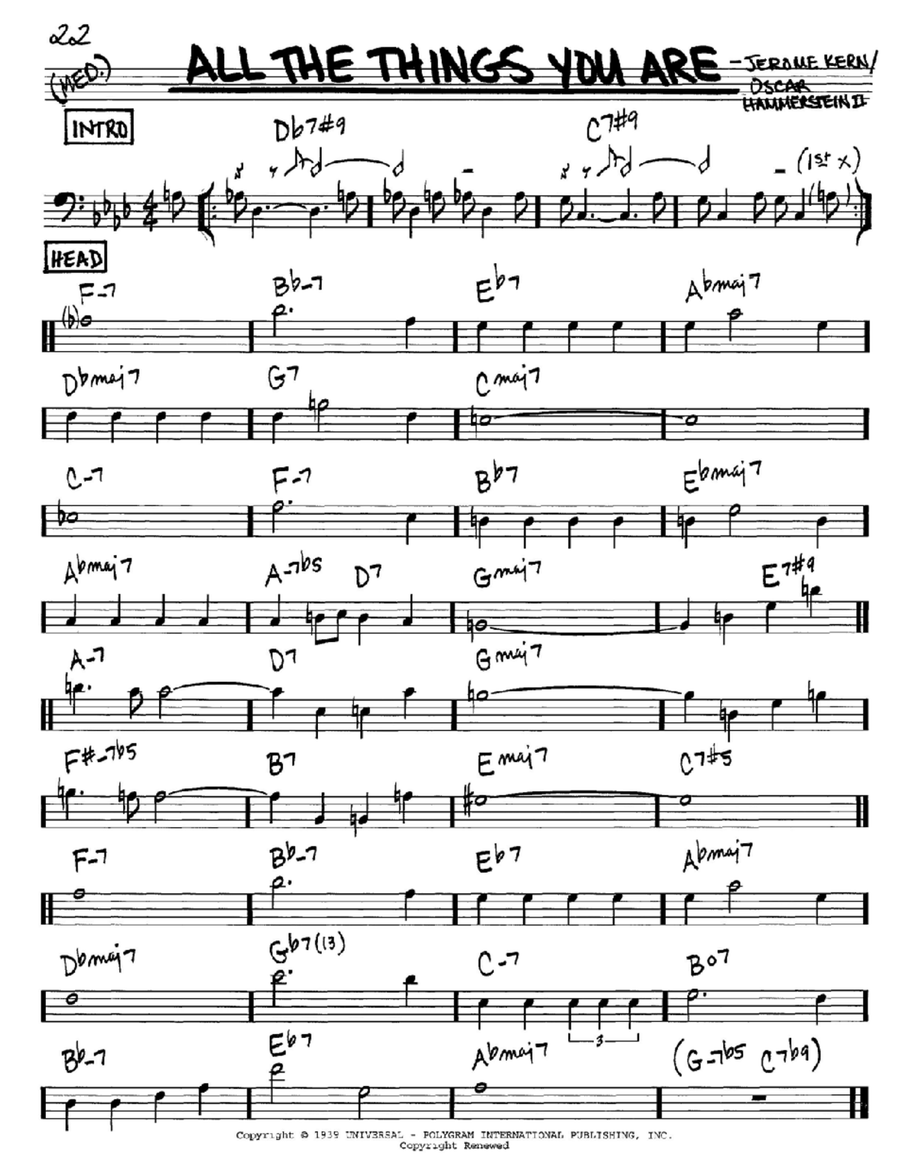
If you’re into playing jazz, you’ll have definitely heard of the song “All The Things You Are” by Jerome Kern. In this post, we’ll dive more deeper into the All The Things You Are lead sheet, because that is the piece of paper many jazz musicians use to learn the framework of the song. The chords, the melodies, and the theory behind the song.
All The Things You Are Lead Sheet Explained
Many jazz educators use this song as great beginning song to introduce aspiring jazz musicians to jazz. In fact, it was my first song. The reason? It has many 2 5 1s, in a variety of keys, and the melody is simple. If you want to learn how to play it, you wouldn’t have a hard time with it.
In order to take it to those higher levels, this song gives you that perfect breathing room. Plenty of minor 7th chords to memories new voicing to try, plenty of 2 5s to figure out if you need to approach it altered or not.
All by all, the All The Things You Are lead sheet is a must know piece. With that being said, let’s dive in and learn!
The Chords
As far as the harmony goes, there’s not much going on. We’ll skip the intro for a moment, the first line is simply a bass ostinato.
On line 2, the head starts. The most interesting thing doesn’t happen until line 5, when we end with E7 #9. Why is that interesting? Because up util that point, we’ve only dealt with regular 7th chords. Minor 7, major 7, dominant 7, half diminished. We hadn’t seen extensions yet, until E7 #9. We’ll come back to that later.
Two lines further, we run into C7 #5, which this isn’t now an extension, but an augmented chord, which while part of the regular 7th chords, isn’t part of the regular diatonic system of a given major key. It’s more part of the melodic minor family. More on that later.
The second to last line has Gb7 (13). Another extension, 13.
The last chord of the entire thing, has C7 b9. Another extension.
The Melody
The melody is fairly straight forward. Again, it’s just following chord tones. The tones of the chord if you will. Thirds, fifths and what not. This is actually a very good way to practice your chord tones.
Conclusion
The first lesson of today is about the chords. There are some irregularities. Things that you might ask, why are these things here. These extensions. Why are these choices made. Are they even necessary? We’ll update the post as time goes on. Stay tuned for more! Make sure to check out minedit.com.